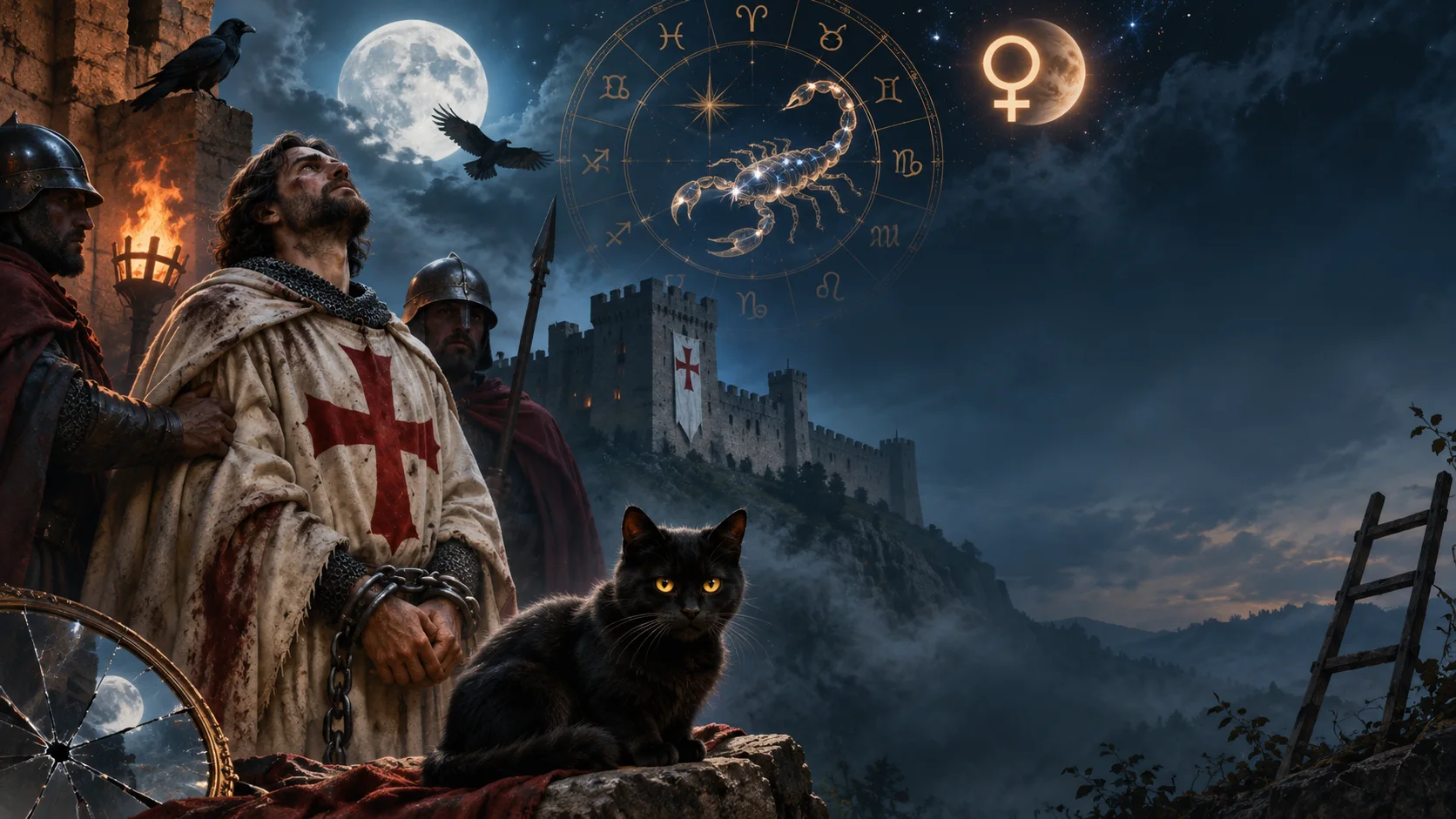
13 October 1307. France. On the orders of King Philip IV, the mass arrests of the Knights Templar begin. An order that wielded enormous influence only yesterday is now declared a gathering of heretics. Investigations involving torture, trials and the stake lie ahead.
And all of this happened on Friday the thirteenth.
There you have it: the perfect origin story for a cursed day! Especially if you remember the legends about the Templars’ secret knowledge and the curse supposedly laid upon their persecutors.
Unfortunately, historians spoil the picture somewhat. There is no convincing evidence that the destruction of the Templars gave rise to the superstition surrounding Friday the thirteenth. Written references treating this combination of weekday and date as unlucky appear much later.
But when has a detail like that ever stood in the way of a good legend?
The number thirteen’s bad reputation is not quite so straightforward either. People usually bring up the Last Supper, where Christ sat at the table with twelve apostles. Friday is associated with the Crucifixion. A perfectly convenient explanation if you have already decided that the date must be unlucky.
Kabbalah, however, has a rather different answer.
Hermetic Kabbalah uses gematria: the numerical values of the letters of the Hebrew alphabet. These values are used to examine relationships between words, names and symbols.
Take the word ahavah (אהבה), meaning love. Its letters have the values 1, 5, 2 and 5. The total is 13.
The word echad (אחד) means “one” or “united”. Its letters have the values 1, 8 and 4. The result is also 13.
Now add the two numbers. You get 26, the numerical value of the Tetragrammaton (יהוה), the four-letter Divine Name.
Curious arithmetic, isn’t it? While some people recoil from the number thirteen, Kabbalistic correspondences connect it with love and unity.
Of course, those correspondences do not mean everyone must fall in love on the thirteenth. But why, then, is the opposite claim — that the number necessarily brings misfortune — taken so seriously by some?
Friday is even more amusing.
In Western planetary magic, each day of the week is governed by a planet. Friday belongs to Venus. This correspondence appears in classical grimoires, including the Key of Solomon and the Heptameron.
Venus governs love and attraction. On the Kabbalistic Tree of Life, its sphere is Netzach, the seventh Sephirah.
From the standpoint of planetary magic, then, Friday hardly looks like such a terrifying day.
That leaves our ominous thirteen.
In Tarot, the thirteenth trump is called Death. Surely that settles it! Yet anyone whose acquaintance with Tarot extends even slightly beyond newspaper horoscopes knows that reading this card literally is a rather crude mistake.
In the system of the Hermetic Order of the Golden Dawn, Atu XIII corresponds to the Hebrew letter Nun (נ) and the zodiac sign Scorpio. On the Tree of Life, it is assigned to the twenty-fourth path, connecting Tiphareth with Netzach.
Tiphareth corresponds to the Sun, while Netzach, as we have already established, corresponds to Venus.
An interesting coincidence appears here: Friday is ruled by Venus, and the path of the Death card connects with its Sephirah.
One should not, however, confuse the number of a Tarot trump with the number of a path. The thirteenth path of the Tree of Life corresponds to Gimel and the High Priestess. Death, despite being trump XIII, occupies the twenty-fourth path.
Venus itself corresponds directly to trump III, the Empress, and the letter Daleth. Calling trump XIII a Venus card would therefore be an error. Its astrological correspondence is Scorpio.
In Aleister Crowley’s Thoth Tarot, the symbolism of Death unfolds through alchemical transformation. Decomposition is necessary for a new form to emerge. The former state ceases to exist, but life itself does not end there.
Admit it, that is rather different from the familiar picture of a skeleton with a scythe coming specifically for you.
Naturally, with enough enthusiasm, one could build an entire doctrine around these correspondences. Declare Friday the thirteenth a day of secret initiation, then offer an expensive ritual to remove an ancient curse.
An exceptionally ancient curse, of course. Preferably dating back to the Templars.
I would only suggest looking for such a rule in the primary sources of Western magic first. I suspect the results would be rather disappointing.
What surprises me more is how willingly people allow superstitions to run their lives.
Someone wakes up, looks at the calendar — Friday the thirteenth. That’s it: the day is ruined before it has even begun. Drops a cup? A bad omen. Business negotiations go poorly? Well, what else could you expect on a day like this?
And if everything goes wonderfully? That is no longer interesting. Good fortune does not fit the story of a cursed number.
A person can create problems simply by expecting them, and then treat those problems as proof that the fear was justified. Psychology has long known such mechanisms, but for a lover of mysticism it is much more satisfying to blame the calendar.
I have practised magic for many years, and I consider work with one’s own will to be one of its most important elements. That is why I find it rather strange when someone who talks about magical powers and controlling their own destiny suddenly becomes afraid of two digits.
If you are capable of directing your own life, why hand that power over to a calendar?
So you can spend Friday the thirteenth expecting disaster. Or you can go about your day. If magical symbolism appeals to you, think of Venus and the Kabbalistic correspondences of love.
Personally, I see no reason to fear this day.
After all, far more dangerous than any supposedly unlucky number is the habit of handing responsibility for your life to anything and anyone but yourself.